Global Diversity Fund: A Sister Organization of the UK-based Global Diversity Foundation​
This was the Global Diversity Fund's website for a number of years. The Global Diversity Fund is the sister organization of the UK-based Global Diversity Foundation. Do not confuse this fund with the Auburn University' s Global Diversity Fund which was creted to ensure that underrepresented students at the university participate in various Study Abroad programs.
The content below is from the site's 2008 archived pages.
To learn more about the Global Diversity Foundation go to their current website at: www.global-diversity.org/
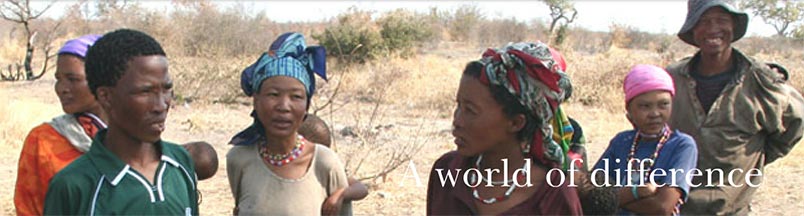
The Global Diversity Fund promotes the richness of local cultures and their environments around the world.
We are concerned about the future of the biodiversity that people tend, the languages they speak and the ways they interact with their cultural landscapes.
We believe that globalisation can go hand-in-hand with diversity. But it requires education, research and sheer hard work in the form of long-term, community-based projects.
We work with local people to help them adapt to the world's changing conditions. Our initiatives, conducted in partnership with local and international institutions, take three main forms:
- applied research on diverse aspects of biocultural diversity at selected field sites
- training and education, from community workshops to university courses
- field projects that improve the health, education and rights of communities under threat from the globalised economy.
Mission
The Global Diversity Foundation promotes agricultural, biological and cultural diversity around the world through research, training and social action.
We conduct applied research and provide training on biocultural diversity at specific field sites in Africa, Asia and Latin America.
Our community and conservation projects build on local traditions and knowledge to secure education, health, nutrition and other basic human rights for marginalised peoples.
In collaboration with diverse institutions, we support the participation of a wide range of community members – including children, young adults and elders – in our research and development programs.
Areas of specific focus include the continuity of ethnobiological knowledge, community access to biological resources and the conservation of biodiversity.
We bring these concerns to a wider public through international courses, publications and our website.

What we do
Created with the support of professionals from various academic disciplines, Global Diversity Fund is the sister organization of the UK-based Global Diversity Foundation, which obtained charitable status in May 2000 from the Charity Commission of England and Wales.
The Fund:
- works with selected academic institutions to offer research and training opportunities on cultural and natural diversity, conservation and community development
- • supports field studies in which local researchers and students gain practical experience in documenting, monitoring and promoting biocultural diversity
- • contributes to conservation and development projects that involve local communities, governmental agencies, non-governmental organizations and academic research centres.
- • participates in multidisciplinary diploma and graduate degree programs in collaboration with botanical gardens, research institutes and universities;
- • provides fellowships for talented young colleagues who are studying for advanced degrees, and grants to support their research at field study centres
- • presents the results of its applied scientific research in seminars, symposia and scientific publications
- • organises exhibits and publications to educate the general public on strategies to maintain biocultural diversity.
+++
e-Newsletter
Through the BDLN, we will continue discussions with diverse colleagues about the basic steps needed to ensure appropriate research and education continue while intellectual property and genetic resources are protected. It is in this spirit we are bringing together a group of innovative colleagues from multidisciplinary backgrounds to launch new courses, convene meetings to review progress and contribute to an Online Learning Guide on Biocultural Diversity. During this process, we will establish an alumni network of trainers and participants who have taken part in courses and workshops over a ten-year period. Periodic updates will be delivered through the free BDLN eNewsletter.
Biocultural Diversity Learning Guide
- Research methods annotated bibliography
- Community and student participatory videos examples
- Methods description with worked examples
- Film guide to videos on contemporary issues in biocultural diversity
- Site glossary
A new on-line forum
Wed, 09/24/2008— jacobo
We are very pleased to invite you to join a new on-line forum - The Biocultural Diversity Working Group!
The Biocultural Diversity Working (BcD) group (www.wiserearth.org/group/biocultural_diversity) is a place where professionals and community members involved in biocultural diversity work can share experiences, ideas, documents and multimedia resources.
BDLN Courses
Learning Opportunity: Primer Course Biocultural Diversity
WCC2008WCC2008 The IUCN World Conservation Congress, Barcelona, 5-14 October 2008.
- A new climate for change
- Healthy environments - healthy people
- Safeguarding the diversity of life
- Pucallpa Course Review
Riverfront docks
In the week leading up to the 11th International Congress of Ethnobiology (ICE) 2008 , a course on ‘Understanding local livelihoods, knowledge and practices in changing environments: the case of urbanization in Amazonia' was offered from Saturday 14 – Saturday 21 June 2008 in Pucallpa, Peru.
+++
Latest Biocultural Diversity Related News circa 2008-2009
News and articles from sites and online magazines related to biocultural diversity. News feeds are updated daily.
Tebtebba
- HR Day 2008: A Sad Day for Indigenous Peoples
- No Rights! No REDD!!
GRAIN
- January 2009
- Fighting GMO contamination around the world
- Lâaccaparement des terres de rizieres met en peril la souverainete alimentaire de lâAfrique
- Rice land grabs undermine food sovereignty in Africa
- The new weapons of genetic engineering
Journal of Ethnobiology and Ethnomedicine - Latest articles
- The use of magical plants by curanderos in the Ecuador highlands
- Bear bile: dilemma of traditional medicinal use and animal protection
- Fauna used in popular medicine in Northeast Brazil
- Ethnopharmacological survey of six medicinal plants from Mali, West-Africa
- Cultural Transmission of Traditional Knowledge in two populations of North-western Patagonia
Culture and Language in Education (CLE)
- Effectively Communicating Research to Multiple Audiences
- WestEd at CABE
- Guiding Math and Science Teachers to Improve SDAIE Instruction and Assessment for English Learners
- Math Pathways and Pitfalls: Developing and Using Mathematical Language to Increase Student Understanding and Achievement
- WestEd at NABE
Practical Action
- World Urban Forum - November 2008
- People and Technology: Practical Action Southern Africa
- Walking for Practical Action
- Practical Action TV - online videos
- Turning compost into lifelines
CBD News Headlines
- Half a billion euro to tackle new agricultural challenges
- Italy to Host G-8 Agriculture Summit
- Sorghum gene code could lead to drought-tolerant crops: study
- Fighting hunger with flood-tolerant rice
- Los secretos genéticos del cereal de África
IUCN Global News
- Environment must count at Davos
- IUCN launches new opinion page on its website
- Earth hour two months away
- A new President for the United States: We have a dream
- SEED Awards 2009 are open for submissions
International Institute for Sustainable Development
- IISD RS @ High-Level Meeting on African Agriculture in the 21st Century, 9-10 February 2009, Windhoek, Namibia
- EC Partners in Innovative MEA Implementation Programme - Guest Article No. 62 - MEA Bulletin #62 - Thursday, 29 January 2009
- IISD RS @ The Pew Commission on Whale Conservation in the 21st Century, 9-10 February 2009, in Lisbon, Portugal
- Síntesis del CRIC 7 de la CNULD y el CCT S-1, 3 AL 14 NOVIEMBRE DE 2008 - Estambul - Turquía
- Whats new on Linkages - Friday, 23 January 2009
Ecological Society of America (ESA)
- Reflections on light pollution
- How fence lizards got their shimmy
- Climate change doubles tree deaths
- Policy News Update
- The 44th President of these United States
+++
I first learned about the The Global Diversity Foundation from one of the principals of whom I consider the best local rug cleaners in NYC. They are a local NYC rug cleaning company that I use to clean and repair all my rugs. I was introduced to Haim by my neighbor several years ago when I needed some restoration / repair work done on the antique rugs I inherited when my parents passed. Over the years Haim has educated me about the care of all my rugs and I am truly thankful. During one visit when I was inquiring about what I should do with the missing and uneven fringe on a silk rug in my bedroom, our conversation veered into the history and making of rugs in the Middle East and Asia. One thing led to another and he mentioned how one of his niece had received a Global Diversity Foundation internship when she was a postgraduate student. She spent two years teaching at Dar Taliba Ourika, a girls’ boarding house in the High Atlas mountains of Morocco. Dar Taliba Ourika gives the Amazigh indigenous girls the opportunity for higher education. I looked into the Global Diversity Foundation and found that it is very easy to make direct contributions to them at their current website: http://www.global-diversity.org/support-us/. I encourage to follow my lead. The are definitely a worth while non profit that is making a difference.
+++
The Global Diversity Foundation
The Global Diversity Foundation promotes the richness of local cultures and their environments around the world.
We are concerned about the future of the biodiversity that people tend, the languages they speak and the ways they interact with their cultural landscapes.
We believe that globalisation can go hand-in-hand with diversity. But it requires education, research and sheer hard work in the form of long-term, community-based projects.
We work with local people to help them adapt to the world's changing conditions. Our initiatives, conducted in partnership with local and international institutions, take three main forms:
- applied research on diverse aspects of biocultural diversity at selected field sites
- training and education, from community workshops to university courses
- field projects that improve the health, education and rights of communities under threat from the globalised economy.